Loading latest posts

Jerywin Bayawan
Public
PortfolioPublic post
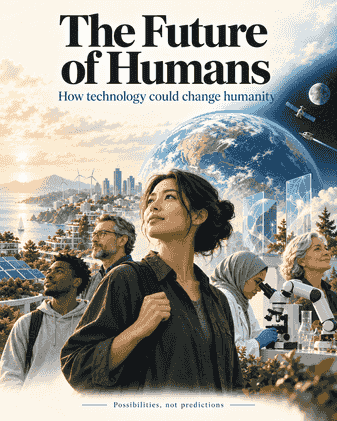
The Future of Humans: How Technology Could Change Humanity
The future of humans will likely involve more capable machines, changing medical treatments, greater demand for electricity, and societies adapting to environmental and demographic pressures. These developments could improve lives substantially, but their benefits will depend on affordability, reliability, governance, and access. Predictions become increasingly uncertain beyond the next few decades. Neither a technological utopia nor human catastrophe is inevitable.
Research checked on September 18, 2026. Dates below describe the cited evidence or scenario horizon, not guaranteed breakthrough deadlines.
Where Humanity Stands Today
Humanity already has important pieces of what once looked futuristic: AI systems that generate software, genome editing approved for specific diseases, and experimental implants that translate neural activity into speech. Yet capability has different meanings in each field. A commercial service, a regulated treatment, and a research demonstration should not be treated as equally mature.
For example, the FDA approved the first CRISPR-based treatment in December 2023, while speech neuroprostheses described by university researchers in 2025 remained experimental systems developed around individual participants. Both are meaningful advances, but neither establishes unlimited control over human biology. FDA approval announcement, UC Davis speech-interface research.
This article uses five distinctions:
- Currently demonstrated: a capability has been shown, within stated conditions.
- Under development: researchers are actively trying to make it practical.
- Projected: an identified model estimates an outcome under assumptions.
- Plausible but uncertain: a scenario is consistent with available evidence but cannot be forecast reliably.
- Speculative: evidence is insufficient to establish feasibility or timing.
A useful question for every announcement is: what exactly worked, for whom, for how long, and under whose supervision?
Humans and Artificial Intelligence
AI could become a more common interface between people and complex digital systems. Instead of navigating every application manually, users may describe a goal and review proposed actions.
The February 2026 International AI Safety Report describes improving capabilities in coding, mathematics, and autonomous operation, alongside persistent failures in extended or unfamiliar tasks. Its evidence supports growing usefulness, not universal competence. International AI Safety Report 2026.
Consider a hypothetical small business assistant that prepares an inventory report. It could gather authorized records, identify unusual movements, and draft an explanation. A person would still need to resolve ambiguous transactions and authorize consequential changes.
Similar collaboration could appear in education, research, and creative work. A teacher might use AI to prepare alternative explanations; a researcher might use it to organize candidate experiments; a designer might compare visual directions. The benefit depends on whether the output improves the actual outcome, rather than merely making production faster.
An attractive interface can hide uncertainty. Future systems should make it easy to inspect evidence, correct assumptions, and reject recommendations. Human participation must include meaningful decision authority.
Will AI Replace Human Jobs?
AI exposure measures the potential for tasks to change; it does not measure how many workers will lose their jobs.
The International Labour Organization's May 2025 analysis estimated that one in four workers worldwide held an occupation with some generative-AI exposure. It concluded that transformation was more likely than complete replacement for most occupations, because jobs contain tasks requiring human input. This was a task-based assessment, not a count of observed layoffs. ILO occupational-exposure study.
Possible changes include:
| Occupation | Tasks that could become more automated | Responsibilities requiring continued attention |
|---|---|---|
| Software developer | Drafting code, documentation, and routine tests | Requirements, security, architecture, and verification |
| Teacher | Preparing exercises and initial feedback | Motivation, safeguarding, and assessing understanding |
| Accountant | Categorization and reconciliation assistance | Exceptions, controls, and professional accountability |
| Designer | Producing variants and preliminary assets | Creative direction, accessibility, and client needs |
| Customer-support worker | Answering routine requests | Disputes, unusual cases, and sensitive decisions |
These are illustrative task divisions, not forecasts that each occupation will evolve identically.
Employment outcomes will also depend on demand, wages, organizational choices, and policy. A business could use productivity gains to expand services, reduce staffing, or shorten working hours. Technology alone does not determine which outcome follows.
The Rise of Humanoid Robots
Robotics could extend automation into more physical settings, but a convincing demonstration does not establish dependable performance throughout a working day.
The International Federation of Robotics' January 2026 outlook describes humanoids moving toward real deployments while emphasizing unresolved demands around reliability, dexterity, energy use, maintenance, and industrial productivity. As an industry organization, it provides a useful deployment perspective rather than an independent guarantee of future adoption. IFR robotics trends for 2026.
Human-shaped machines could be useful in environments built for people. Nevertheless, a specialized machine may be cheaper and more reliable for a repetitive task.
A household also presents a different problem from a controlled production line. Objects move, children behave unpredictably, and failure may injure someone. A practical robot must recognize uncertainty, stop safely, and recover from mistakes.
More physical tasks becoming automated is plausible. A reliable date when robots will replace most physical occupations is not available.
Could Humans Live Much Longer?
The most useful distinction is between lifespan, the length of life, and healthspan, the years lived with good health and functional independence.
Treating a disease can improve survival without reversing biological aging. Likewise, changing a molecular marker does not establish that someone will remain healthy longer.
A 2024 analysis in Nature Aging found slowing improvements in life expectancy across the populations studied. Its authors argued that radical extension would be unlikely without interventions that substantially alter aging itself. This is evidence against simply extrapolating historical gains indefinitely; it does not prove that future breakthroughs are impossible. Olshansky and colleagues' study.
What does newer rejuvenation research demonstrate?
On June 9, 2026, Life Biosciences announced that the first participant had received ER-100 in a Phase 1 trial for optic neuropathies. The company described safety and tolerability as primary concerns, with additional assessments of visual function. This is a sponsor-reported clinical milestone, not evidence that whole-body aging has been reversed or human lifespan extended. ER-100 trial announcement.
Research into regenerative medicine, cell therapies, and replacement tissues could eventually reduce particular forms of disability. However, repairing one organ would not automatically rejuvenate the brain, immune system, or every other tissue.
Stronger longevity claims require controlled human studies, clinically meaningful outcomes, long follow-up, and evidence that benefits outweigh harms. Animal experiments and biological-age measurements can inform research without establishing extra decades of healthy human life.
Could Humans Merge With Computers?
Brain-computer interfaces, or BCIs, create a communication pathway between neural activity and an external device.
In June 2025, UC Davis researchers described an implanted system that translated one participant's attempted speech into audible output with expressive features. Berkeley researchers also reported streaming speech reconstruction in a participant with paralysis in March 2025. These demonstrations concern restoring communication under specific experimental conditions. UC Davis study overview, Berkeley research overview.
They do not demonstrate unrestricted access to private thoughts, downloadable knowledge, or a merger between a human mind and an AI system.
Medical interfaces could become more useful if they remain reliable over years, require less calibration, and become easier to maintain. Elective cognitive enhancement is a separate proposition: people without a serious impairment may reasonably demand a different balance of surgical risk and benefit.
Potential augmentation also raises practical questions. Who controls the software? Can the user withdraw consent? What happens if a provider disappears? Neural privacy and long-term support would be central design requirements.
Genetic Engineering and the Future Human Body
CRISPR-based medicine is already more than a laboratory concept. The FDA's 2023 approval of Casgevy established a clinical use for editing patients' blood-forming stem cells to treat a specific disease. It did not authorize general enhancement of human traits. FDA announcement.
Somatic editing targets cells in the treated person. Heritable editing involves changes that could pass to descendants. The scientific and ethical stakes differ because future generations cannot consent to inherited interventions. WHO's governance recommendations address oversight, transparency, and the risks of irresponsible applications. WHO human genome editing recommendations.
Correcting a well-understood disease mechanism does not establish an ability to design intelligence, personality, or athletic ability safely. Large-scale enhancement would require reliable knowledge of intended effects, unintended interactions, and consequences across generations.
Human evolution and technology may increasingly interact through medicine and reproductive choices. That does not justify predicting a uniform, genetically redesigned population by 2100.
Energy and the Civilization of the Future
Future technology depends on physical infrastructure. Computing, electrified transport, cooling, manufacturing, and medical facilities all require dependable power.
The IEA's Electricity 2026, published on February 6, identifies growing demand from electrification, data centers, and AI. It emphasizes grids and flexibility as essential to integrating changing generation and consumption patterns. IEA Electricity 2026.
A plausible future combines renewable generation, batteries, stronger transmission, demand management, and dispatchable sources, including nuclear power where countries choose it. The mix will vary with geography, financing, regulation, and existing infrastructure.
Fusion research could eventually add another option. However, a successful experiment and an economical power station are different achievements. Commercial usefulness requires dependable operation, maintainable equipment, and competitive costs; no universal arrival date follows from laboratory progress. US Department of Energy fusion overview.
AI could help operate energy systems while also increasing their electricity requirements. The IEA examines both effects rather than assuming that efficiency gains automatically cancel demand growth. IEA Energy and AI.
Climate Change and Future Human Civilization
Climate change will influence the conditions under which every other technology operates.
The IPCC concludes that additional warming increases multiple hazards and that adaptation becomes less effective as warming rises. Outcomes depend on emissions pathways and exposure; there is no single unavoidable climate outcome for 2100. IPCC synthesis findings.
For households and businesses, adaptation could mean redesigned buildings, different working hours, flood protection, improved water management, or relocation from increasingly exposed areas. Some communities will have far more resources to respond than others.
Reducing emissions and adapting serve different purposes. Adaptation manages impacts; mitigation limits further warming. Both matter, and some losses cannot be fully prevented through adaptation.
A future city might therefore look less like a science-fiction skyline and more like an ordinary city with better drainage, cooler housing, reliable transit, and resilient electricity. That is a scenario grounded in practical needs, not a prediction of one universal urban design.
Population, Aging, and the Future of Society
Demographic change can reshape societies even without revolutionary inventions.
The UN's 2024 population projections estimated a global peak of roughly 10.3 billion people in the mid-2080s. This is a dated projection based on assumptions about fertility and mortality, not a measured future population. Regional trajectories differ substantially. UN population projection announcement.
Aging societies may need different housing, care systems, retirement arrangements, and labor policies. Regions with younger populations may face greater pressure to expand education, infrastructure, and employment opportunities. Migration can influence both, but its scale depends heavily on policy and circumstances.
These patterns suggest practical priorities for technology: accessible interfaces, assistive devices, affordable healthcare administration, and tools that help people remain independent.
Urban growth and population decline can also occur in different places simultaneously. National averages should not substitute for local planning.
Will Humans Live on the Moon or Mars?
The Moon: sustained exploration before independent settlement
NASA describes Artemis and its Moon-to-Mars architecture as efforts to develop long-term exploration capabilities. Its architecture is explicitly not a fixed mission schedule. Commercial orbital destinations are also under development. These are programs and plans, not completed independent communities. NASA human-spaceflight destinations.
A permanently occupied outpost would require continuing logistics, power, maintenance, and life support. An economically and materially independent settlement would be a much larger achievement.
Mars: transportation is only one obstacle
NASA groups major human-spaceflight hazards into radiation, isolation, distance from Earth, altered gravity, and hostile or closed environments. These interact rather than operating separately. NASA spaceflight hazards.
A Mars mission would also need robust food supplies, medical capabilities, equipment repair, and communication systems that tolerate delay. Settlement would extend these requirements from a mission duration to an indefinite future.
Whether people could remain healthy and reproduce safely across generations in reduced gravity remains an unresolved requirement, not an established capability.
Could humanity become multi-planetary?
It is a plausible long-term ambition, but several distinct milestones are often combined: visiting another planet, maintaining an outpost, sustaining a community, and establishing independence from Earth.
A settlement dependent on continuous terrestrial supplies would not provide the same resilience as an independent civilization. No reliable date can currently be assigned to that final milestone.
A Timeline of Possible Human Futures
The following horizons organize scenarios. They are not deadlines for inventions.
| Horizon | What deserves attention | How to interpret it |
|---|---|---|
| Present–2035 | AI integration, specialized automation, clinical research, grid investment, adaptation, and commercial orbital infrastructure | Mostly existing capabilities and active development; deployment remains uneven |
| 2035–2050 | More automated workflows, potentially broader precision medicine, assistive robotics, and infrastructure renewal | Conditional projections and plausible scenarios |
| 2050–2100 | Different combinations of demographic aging, climate impacts, automation, and possible space outposts | Broad scenarios with widening uncertainty |
| Beyond 2100 | Extensive augmentation, radical longevity, or independent off-world communities | Highly speculative possibilities without reliable schedules |
Present day to 2035: integration matters
Over roughly the next decade, major changes could come from making existing tools reliable and accessible. A hospital improving records, a school evaluating AI tutoring, or a business automating routine administration may have more immediate impact than an unproven breakthrough.
The important questions are whether systems work outside demonstrations, fit existing institutions, and provide benefits after operating costs and failures are included.
2035–2050: institutions shape the outcome
Over approximately 25 years, cities, schools, and businesses could reorganize around different capabilities. More automation might support shorter working hours, expanded services, or concentrated ownership. Those are alternative social outcomes rather than automatic consequences of technical progress.
Humans in 2050 could have more personalized assistance while still facing familiar problems involving housing, trust, healthcare, and inequality.
2050–2100: several futures can coexist
Looking about 50 years ahead, to the 2070s, uncertainty about technological capability becomes much larger. By 2100, useful scenarios include:
- Technology-rich continuity: improved tools and medicine within recognizable social institutions.
- High automation: machines perform many tasks, while societies negotiate income and ownership.
- Uneven augmentation: some people gain advanced medical assistance while others lack basic services.
- Climate-constrained development: adaptation absorbs a growing share of investment and attention.
- Expanded space activity: research outposts grow without replacing Earth as humanity's main home.
These possibilities can overlap. Different regions could experience different combinations at the same time.
What about 2126, 2200, and beyond?
A century from now, scientific breakthroughs and political changes could make today's assumptions look incomplete. For 2200, extensive augmentation, major lifespan extension, and off-world civilization remain speculative scenarios.
A longer timeline does not turn an unsupported idea into an inevitable achievement. Feasibility, desirability, and implementation remain separate questions.
Technologies That Could Transform Humanity
Confidence below refers to the evidence for the stated development, not a numerical probability that it will occur by a deadline.
| Development | Possible time horizon | Current evidence | Major obstacles | Confidence |
|---|---|---|---|---|
| Advanced AI assistants | Available now; further development ongoing | Deployed systems with uneven capabilities | Reliability, security, cost, and evaluation | High for existing bounded uses; uncertain for broad autonomy |
| Highly capable general-purpose robots | Unknown | Specialized deployments and expanding humanoid trials | Dexterity, maintenance, safety, and economics | Limited for unrestricted versatility |
| Major healthy lifespan extension | Unknown | Aging research and early clinical investigations | Demonstrating durable human benefits and safety | Low for radical extension |
| Advanced BCIs | Experimental systems now; wider use uncertain | Individual clinical demonstrations | Surgery, durability, calibration, and access | Strong for specific demonstrations; uncertain for general enhancement |
| Permanent Moon settlement | Unknown | Exploration programs and infrastructure development | Logistics, life support, and sustained funding | Plausible but uncertain |
| Permanent Mars settlement | Unknown | Preparatory research and robotic exploration | Transport, health, supplies, and independence | Highly uncertain |
| Large-scale genetic enhancement | Unknown | Therapeutic editing does not establish enhancement | Trait complexity, safety, ethics, and governance | Speculative at population scale |
| Human-level or general AI | Unknown; definitions differ | Broad but uneven machine capabilities | Generalization, evaluation, reliability, and agreement on criteria | No established arrival date |
The distinctions above draw on the cited AI assessment, IFR outlook, medical research, WHO recommendations, and NASA programs. The timing judgments are cautious editorial assessments, not forecasts issued by those organizations.
Major Risks to Humanity's Future
Different risks have different evidence bases. Serious harm, global catastrophe, and human extinction should not be used interchangeably.
AI misuse and loss of control: The 2026 AI safety assessment discusses observed misuse alongside uncertain future scenarios in which highly capable systems evade effective oversight. It reports disagreement about catastrophic outcomes; laboratory warning signs do not establish that extinction is inevitable or that current systems can cause it independently. International AI Safety Report 2026.
Pandemics and biological risks: Naturally emerging disease and harmful biological applications require surveillance, resilient healthcare, and research oversight. Antimicrobial resistance is already a documented threat that can undermine treatment and medical procedures. WHO antimicrobial resistance fact sheet.
Nuclear conflict: Existing weapons and geopolitical tensions make nuclear risk an ongoing concern. Its mechanisms and evidence differ from hypothetical future technological risks. SIPRI Yearbook 2026.
Climate and environmental degradation: Warming and damage to ecosystems can compound pressures on food, water, health, and infrastructure. Their consequences depend partly on exposure, vulnerability, and collective responses. IPCC synthesis findings.
Asteroid impacts: Planetary defense is a concrete example of reducing natural risk through research. NASA's DART mission demonstrated asteroid deflection, although one successful test does not eliminate every possible impact scenario. NASA DART mission.
Risk reduction should be proportional to evidence, possible severity, and available interventions. Ranking every threat with unsupported percentages would create false precision.
Predictions That Are Not Established Facts
Immortality: No evidence reviewed here establishes that humans can live indefinitely. Stronger claims would require demonstrated long-term survival benefits, not just changes in selected aging markers.
Mind uploading and digital consciousness: Reproducing behavior would not by itself demonstrate that a person's subjective experience had transferred. A credible claim would need a validated account of what is preserved and how continuity could be assessed.
Conscious AI: Fluent self-description is insufficient evidence. Researchers have proposed indicators grounded in theories of consciousness, but such frameworks should not be confused with a conclusive test. Research on consciousness indicators in AI.
Guaranteed AGI dates: A forecast requires a clear definition and credible measurement. A company roadmap or executive prediction cannot substitute for either.
Fully automated societies: Technical capability would still leave questions about deployment costs, ownership, maintenance, law, and human preferences.
Mars cities on a fixed schedule: Renderings and transport ambitions do not demonstrate sustainable habitation. Evidence would need to include reliable life support, logistics, and long-term human health.
Cryonics revival: Preservation services should not be interpreted as proof that revival will become possible. A September 2026 report on an operating facility described the absence of a technology capable of restoring its preserved clients. Reporting on current cryonics limitations.
These ideas can be discussed without presenting them as established science or scheduled products.
What Developers Should Learn From Humanity's Technological Future
Developers can contribute now by building systems whose authority matches their reliability.
For an AI agent, a useful production baseline includes:
- Least-privilege permissions, with authentication and server-side authorization for every protected action.
- Secrets isolated from prompts, generated content, and untrusted tool output.
- Sandboxed execution, restricted network access, and explicit tool boundaries.
- Server-side validation and safe handling of database queries and rendered output.
- Human approval for high-impact actions, including clear details of what will change.
- Audit logs, monitoring, abuse prevention, rate limits, and incident response.
- Recovery paths, tested backups, and safe behavior when dependencies fail.
For example, a reporting assistant may read authorized billing records and draft a summary. Changing payment details should require a separate, enforceable permission boundary. An instruction inside a document must never grant that authority.
These controls assume that model output and external content may be wrong or hostile. They reduce risk without guaranteeing perfect safety. NIST's AI Risk Management Framework provides a broader structure for evaluating systems throughout their lifecycle. NIST AI RMF.
Accessibility, privacy, and resilience belong in the same discussion. A technically impressive service is less useful if people cannot understand it, cannot challenge its decisions, or lose access during ordinary disruptions.
Frequently Asked Questions
What will humans be like in 2050?
People may use more capable digital assistance and different medical treatments. There is insufficient evidence to predict a fundamentally redesigned human species by 2050.
Will AI replace humans?
AI can automate tasks and may eliminate some roles. That does not establish wholesale human replacement; employment outcomes depend on capability, adoption, demand, and institutions.
Could humans become immortal?
Immortality is not a demonstrated scientific outcome. Improving healthspan is a more grounded goal than promising indefinite survival.
Can humans merge with AI?
Experimental interfaces can connect neural activity to computing systems. They do not currently demonstrate a unified human-AI mind or uploaded identity.
Will humans live on Mars?
Human missions and eventual habitation are possible goals. Permanent settlement has no scientifically established completion date.
Could humanity become a multi-planetary species?
Potentially, but an independent population beyond Earth requires much more than landing astronauts or maintaining a supplied outpost.
Will robots replace most physical jobs?
No reliable universal timeline supports that claim. Practical adoption depends on task complexity, safety, maintenance, and cost.
Could genetic engineering change humans?
It already has specific therapeutic applications. Safe enhancement of complex traits across populations remains a different and far less established prospect.
What are the biggest risks to humanity's future?
Climate impacts, pandemics, nuclear conflict, environmental damage, and misuse of powerful technologies all deserve attention. Their likelihoods and potential consequences should be assessed separately.
Can anyone accurately predict humanity in 2100?
Some conditional trends can be modeled. A detailed account of everyday life, politics, or breakthrough technologies in 2100 would exceed what current evidence can support.
The Future Depends on What We Build and Choose
Technology could make human life healthier, more accessible, and more productive. It could also concentrate power, introduce dangerous dependencies, or distribute benefits unfairly.
The outcome will depend on scientific progress, economics, governance, culture, environmental conditions, and events that cannot yet be anticipated. For developers and citizens alike, a practical contribution is to make today's systems trustworthy, preserve meaningful human choice, and update expectations when evidence changes.
Sources and Further Reading
- International AI Safety Report 2026 — capabilities, misuse, systemic risks, and uncertainty.
- ILO: Generative AI and Jobs, 2025 — task exposure and occupational transformation.
- IFR: Robotics Trends 2026 — deployment priorities and practical limitations.
- FDA: First CRISPR-based therapy approval — a verified therapeutic milestone.
- WHO: Human Genome Editing Recommendations — oversight and governance.
- Nature Aging: Radical life-extension analysis — evidence and assumptions behind longevity projections.
- UC Davis: Speech BCI research — experimental communication restoration.
- IEA: Electricity 2026 — electricity demand, grids, and flexibility.
- IPCC: AR6 Synthesis Report — climate evidence and conditional futures.
- UN: World Population Prospects 2024 — demographic projections.
- NASA: Human Spaceflight Hazards — biological and operational constraints.
- NIST: AI Risk Management Framework — responsible system development and evaluation.
Keep exploring