Loading latest posts

Jerywin Bayawan
Public
PortfolioPublic post
Why I Use Semaphore for SMS in Most of My Projects
I use Semaphore for SMS in most of my projects. SMS integration gives an application a way to send short updates to users without requiring them to keep the application open.
This article explains what Semaphore does and where SMS can be useful. The examples below are possible use cases, rather than a record of features I have implemented or my specific reasons for selecting the provider.
What is Semaphore, and what does it do?
Semaphore is an SMS gateway with an API that applications can use to send text messages to Philippine mobile numbers. Its documentation describes submitting messages with an API key, recipient number, and message text, then retrieving message information afterward. Source: Semaphore API documentation
In practical terms, an application decides when a notification is needed, and the SMS integration handles submitting that message to the provider. The application's own business rules still determine who should receive it and what it should say.
How can SMS support user communication?
SMS can bring a short, relevant update outside the application. A user does not need to be signed in to read a standard text message, although mobile service and delivery conditions still matter.
That makes SMS useful as an additional communication channel alongside email and in-app notifications. It works best when the message answers a simple question: What happened, what is coming up, or what should I do next?
A notification should contain enough context to be useful without exposing sensitive information on someone's lock screen.
What are practical use cases for SMS notifications and reminders?
Here are possible examples, not claims about my completed projects:
- Appointment reminders: A booking application could remind a customer about an upcoming appointment and explain how to check the details.
- Order updates: An ordering system could notify a customer when an order is ready for pickup.
- Payment reminders: A billing application could send a reminder before a due date and direct the recipient to a secure account page.
- Schedule changes: A service platform could notify affected users when a confirmed schedule changes.
- Request updates: A customer portal could tell a user that a submitted request has been reviewed and that more information is available in the application.
For example, a pickup notification could say: "Your order is ready for pickup. Please check your account for the collection details."
The value is the connection between a meaningful application event and a clear next step for the user.
How should the Semaphore API key be protected?
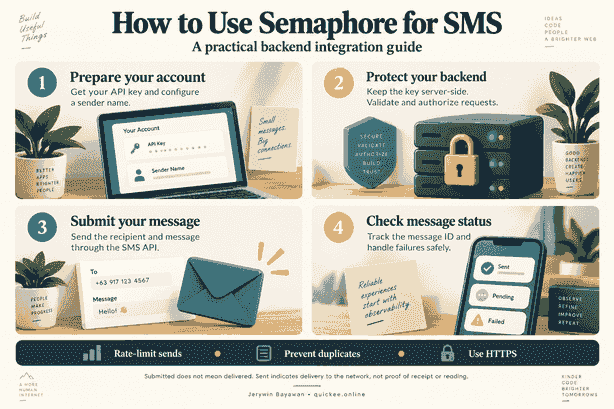
The API key should remain on the backend. Store it in server-side environment configuration or a secret manager, never in frontend JavaScript, a mobile application bundle, or a public repository.
A secure integration should also:
- Authenticate requests and verify that the user is authorized to trigger the notification for the relevant record.
- Validate recipients and message inputs on the server, preferably using controlled templates.
- Use HTTPS and prevent credentials from appearing in application logs or error responses.
- Protect cookie-authenticated actions against CSRF.
- Restrict access to stored phone numbers and message history.
Hiding the key alone is insufficient if an unprotected backend endpoint allows anyone to send messages through it.
Why does SMS integration need rate limiting?
Application-level rate limiting helps control repeated sends, accidental loops, and abuse. Limits can apply per account, recipient, and action, with an overall sending cap where appropriate.
These controls are separate from provider limits. Semaphore documents endpoint-specific request limits and rate-limit response headers, so integrations should follow the current limits for the endpoints they use. Source: Semaphore API documentation
For background processing, a queue can help manage bursts. Retries should be bounded and account for duplicate-send risks: a timeout does not necessarily mean the original message was never accepted.
Does submitting an SMS mean it was successfully delivered?
No. An accepted API request is not proof that a message reached the recipient's phone or was read.
Semaphore documents stages including Queued, Pending, and Sent. Crucially, its documentation defines Sent as delivery to the network. That should not be presented as confirmation of handset delivery or user acknowledgment. Source: Semaphore message status documentation
An application should retain the provider's message identifier, check subsequent status when needed, and display labels that accurately reflect the available evidence. For an important workflow, explicit user acknowledgment may still be necessary.
Frequently asked questions
Can SMS reminders be automated?
Yes. An application's scheduler or background worker can identify eligible reminders and submit messages. It should recheck the underlying record before sending so that cancelled appointments or completed actions do not trigger outdated reminders.
Should every application event trigger an SMS?
No. Reserve SMS for relevant updates, respect communication preferences, and avoid sending several messages about the same event. Routine detail can remain in the application.
Can SMS replace email and in-app notifications?
SMS can complement them. Short alerts suit text messages, while longer explanations, documents, and detailed account information usually belong in another channel.
Should an SMS contain confidential information?
Keep sensitive details out of message bodies. Direct users to an authenticated page when they need to view private information, and never treat possession of a link alone as authorization to access an account.
What matters most in an SMS integration?
My use of Semaphore is one part of the broader topic: connecting application events to useful communication. The practical value of SMS depends on relevant messages, appropriate timing, protected credentials, and honest delivery reporting.
For a project considering SMS, a useful starting question is: Which update would help the user most when they are away from the application?
Keep exploring
Related work
No related items yet.