Loading latest posts

Jerywin Bayawan
Public
PortfolioPublic post
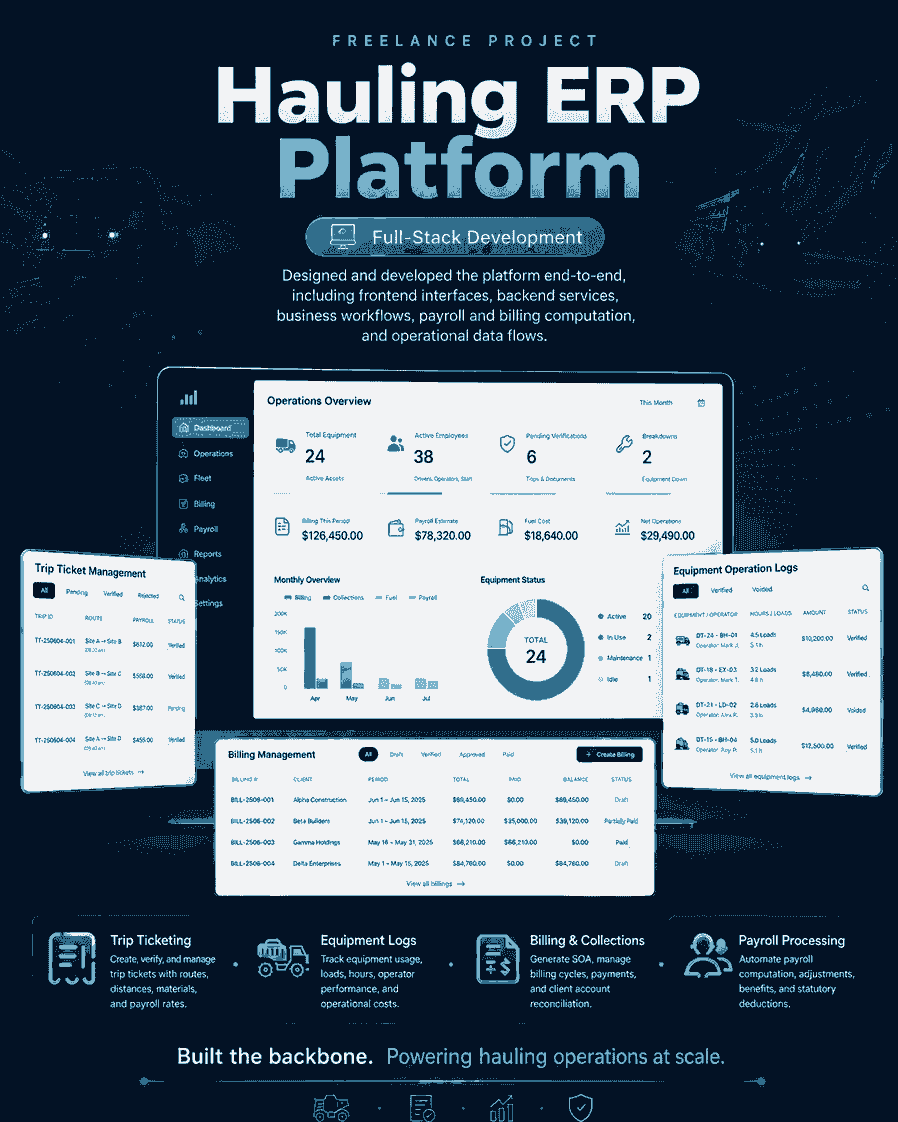
Mining & Hauling ERP Management System
The Mining & Hauling ERP is a comprehensive business management platform designed to centralize the daily operations of hauling, mining support, and heavy-equipment businesses.
The system provides structured master data management for employees, clients, equipment, addresses, billing rates, payroll profiles, and system users. Operational modules handle dump truck trip tickets, equipment tickets, ground staff attendance (DTR), standby records, fuel monitoring, inventory, and business expenses.
Integrated billing and collections functionality allows operational records to be processed into client billings while providing tools for monitoring collections and financial activity.
The platform also includes a dedicated payroll system supporting payroll runs, employee allowances, deductions, cash advances, benefits, and configurable payroll profiles.
For administration and security, the ERP includes role-based access controls and audit trails, helping restrict functionality based on user permissions while maintaining records of important system activities.
The platform provides a centralized workflow from field operations and equipment activity to billing, collections, payroll, and management reporting, reducing reliance on disconnected manual processes and improving operational visibility.
Core Modules: Trip Tickets, Equipment Operations, DTR, Fuel Monitoring, Inventory, Expenses, Billing, Collections & Payroll
Frontend: React.js, Tailwind CSS, Shadcn UI
Backend: Node.js, Express.js
Database: PostgreSQL
Project Type: Mining, Hauling & Heavy Equipment ERP
Keep exploring
Related work
Project
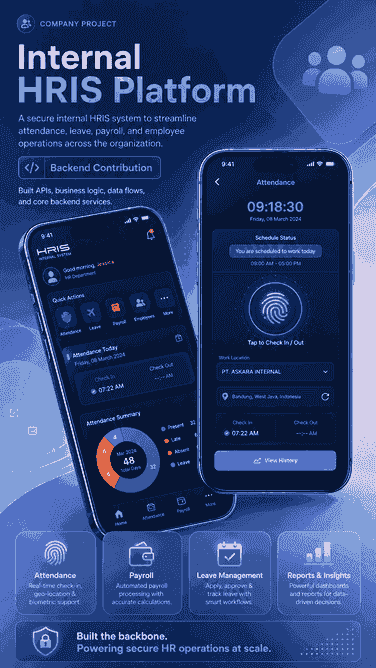
Enterprise Human Resource Information System (HRIS)
The HRIS is an internal enterprise platform designed to streamline and centralize the company's human resource operations. It provides HR administrators, managers, and employees with tools for managing employee information, attendance, payroll, leave requests, approvals, recruitment, company assets, disciplinary records, announcements, and internal communications. My primary role on the project was **Backend Developer and Quality Assurance (QA)**. I contributed to backend functionality, API integrations, database operations, business-logic implementation, validation, and system reliability while also testing workflows across different modules and user roles. As part of QA, I helped verify features against business requirements, identify functional and workflow issues, test API and frontend interactions, validate role-based access and data consistency, and coordinate fixes with the development team before deployment. The system also supports mobile geolocation-based attendance, real-time updates and messaging, notification workflows, reporting, employee approvals, and administrative dashboards, providing the company with a centralized solution for day-to-day workforce management. **Role:** Backend Developer & Quality Assurance (QA) **Project Type:** Internal Company System / Team Project

Project
ZPay — Billing, Collection & Payment Management System
**ZPay** is a billing, collection, and payment management platform designed to help businesses manage **customer accounts, billing records, payment collections, outstanding balances, and recurring financial obligations** from a centralized system. It supports different billing and collection workflows, including **installment, recurring, flexible, and one-time payments**, making it adaptable to different business requirements. ## Billing & Collection Management ZPay provides centralized tools for managing the complete billing and collection workflow. Businesses can create customer billing accounts, track outstanding balances, record payments, monitor collection progress, and identify overdue accounts. The platform provides visibility into **collected, pending, due, and overdue payments**, helping administrators and collectors monitor day-to-day collection activities. ## Online Payments with PayMongo ZPay includes **PayMongo payment integration**, allowing businesses to accept supported online payments directly through their billing and collection workflow. Online transactions are recorded within the system, allowing businesses to maintain centralized payment histories while using PayMongo for payment processing. ## Flexible Billing Options The platform supports multiple billing types for different collection requirements: - **Installment** — scheduled payments divided across an agreed payment period. - **Recurring** — repeating billing for ongoing services or obligations. - **Flexible** — customers can make partial payments without a fixed installment schedule. - **One-Time** — billing intended to be settled through a single payment. ## Collection Monitoring ZPay provides dashboards and reporting tools for monitoring collection performance, including: - Collected payments - Pending collections - Due and overdue accounts - Customer balances - Payment histories - Collection activity - Penalties and outstanding amounts These tools provide businesses with a clearer view of their receivables and day-to-day collection operations. ## Customer & Collector Management The system provides structured management of **customers, billing accounts, collectors, payments, and collection activities**. Role-based functionality helps control what different users can access and perform within the platform, supporting organized collection workflows and administrative oversight. ## Penalties & Due Management ZPay can manage due dates, grace periods, and configurable penalties for overdue billing accounts. This allows businesses to track additional charges and maintain accurate outstanding balances as payments are collected. ## Web & Mobile Experience The platform is designed for responsive use across **desktop and mobile devices**, supporting administrators and collectors working in different environments. Its collection workflows are designed to make recording and monitoring payments efficient while keeping billing information synchronized and accessible. ## Technology Stack - **Frontend:** React.js, TypeScript, Tailwind CSS - **Backend:** Node.js, Express.js - **Database:** PostgreSQL - **Cache & Background Processing:** Redis, BullMQ - **Mobile:** Capacitor - **Payment Integration:** PayMongo - **Deployment:** Docker - **Architecture:** REST API, Offline-First & Cloud Synchronization ## Project Type **Billing, Collection & Payment Management Platform**

Post
About Jerywin Bayawan
Jerywin Bayawan is a **Full-Stack Software Developer** focused on building practical, scalable, and reliable software solutions for real-world business operations. His work covers the full development lifecycle, from designing user interfaces and backend architecture to developing APIs, databases, integrations, and production-ready applications. ### Full-Stack Development His experience covers both **frontend and backend development**, working with technologies such as **React, TypeScript, JavaScript, Node.js, PostgreSQL, Redis, Tailwind CSS, and Docker**. He uses these technologies to build: - Modern web applications - REST APIs and backend services - Real-time application features - Data-driven business systems - Responsive user interfaces - Scalable application architectures ### Systems and Business Solutions Jerywin has contributed to and developed software for different business and operational areas, including: - **HRIS, payroll, and attendance** - **Property and rental management** - **Payment and collection management** - **Restaurant ordering and POS** - **Inventory management** - **Fleet and hauling operations** - **Content management systems** These projects have provided practical experience in translating business requirements into software that helps organize information, simplify workflows, automate processes, and support daily operations. ### Development Approach His development approach focuses on **maintainable architecture, secure APIs, database design, application performance, and responsive user experiences**. Rather than developing features only for technical complexity, Jerywin focuses on understanding the operational problem behind each requirement and building solutions that remain practical and maintainable as the system grows. ### Projects and Technical Writing Through this portfolio, Jerywin shares his **software projects, development experience, technical guides, and lessons learned while building real-world applications**. His work reflects an ongoing interest in improving how software is **designed, developed, secured, deployed, and maintained** while using technology to solve practical business problems.